

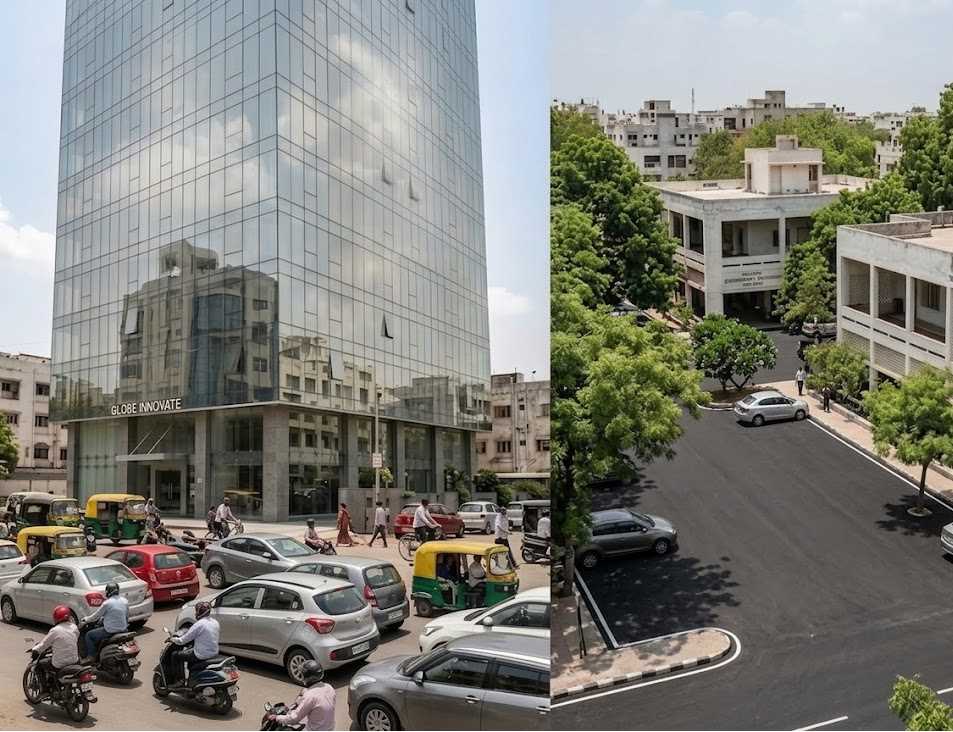
We are losing something precious. Not just trees. But the very idea of living.
On the name of development, we cut down every green thing. Then we pour concrete. Then we add glass. Lots of glass.
What Replaced Our Old Buildings?
Traditional Buildings vs Modern Glass Towers
| Feature | Traditional Building | Modern Glass Tower |
|---|---|---|
| Walls | Thick brick (insulated) | Thin glass (transparent) |
| Height | 1–2 storeys | 20–50 storeys |
| Temperature | Naturally cool | Oven-like |
| Air cooling | Luxury | Necessary for survival |
Glass looks rich. But it traps heat like a car on a summer day.
The Thermal Cost of Progress
Here is what happens inside a glass building:
- Sunlight enters. Heat stays trapped.
- AC runs from March to November.
- Electricity bills skyrocket.
- Rent for one floor becomes unaffordable.
We moved air cooling from a luxury to a necessity.
The Vertical Lie
Builders say vertical growth is efficient. They are wrong.
They pile up concrete without planning. Roads remain broken. Construction work never ends.
Urban Problems and Daily Employee Impact
| Problem | Effect on Employee |
|---|---|
| Untarred roads | 2 hours extra commute |
| Road digging every month | Late arrival every day |
| No footpaths | Risk of injury |
| Poor public transport | Forced to drive |
You leave home at 8 AM. You reach office at 10:30 AM. You are already tired.
The Late Night Trap
You work late to make up time. Then a meeting appears.
Western clients want calls at 8 PM IST.
One meeting becomes three. You eat dinner at 11 PM. You sleep at 1 AM.
Health Consequences of the Late-Night Work Cycle
| Health Consequence | Result |
|---|---|
| Irregular sleep | Chronic fatigue |
| No family time | Broken relationships |
| Stress eating | Obesity |
| No exercise | Heart disease |
Where is the essence of living? It has disappeared.
The Startup Squeeze
Commercial building prices are insane. Let me show you why.
Average Office Rent vs Startup Budget (500 sq ft)
| City | Average Rent (500 sq ft office) | % of Startup Budget |
|---|---|---|
| Mumbai | ₹1,50,000/month | 60–70% |
| Bengaluru | ₹1,20,000/month | 50–60% |
| Gurugram | ₹1,00,000/month | 45–55% |
Note: These numbers are from 2025–2026 real estate reports.
What happens to a hardware startup with this math?
City Office vs Rural Shed: Hardware Startup Trade-offs
| If You Stay in City | If You Move to Rural Area |
|---|---|
| Rent a tiny 150 sq ft space | Rent a large 1000 sq ft shed |
| No room for tools or machines | Hours of travel through traffic |
| Landlord bans electronics testing | Talented employees refuse to relocate |
| You cannot build anything real | You cannot retain anyone good |
The Cramped Reality
Picture this. A startup wants to build a medical device. They need:
- A 3D printer
- A small CNC machine
- A soldering station
- An oscilloscope
- Space for 5 engineers to stand and think
In a city office, this is impossible.
You cannot fit a CNC machine in a 200 sq ft room. You cannot test a sensor prototype. You cannot even hammer a bracket without a noise complaint.
What Are Indian Startups Reduced To?
Only software. Only services. Only code.
Look at the list:
What Startups Should Build vs What They Actually Build
| What Startups Should Build | What Startups Actually Build |
|---|---|
| Medical devices | Food delivery apps |
| Machine parts | EdTech videos |
| Industrial sensors | Fintech dashboards |
| Defence equipment | E-commerce websites |
| Robotics components | CRM software |
Where is the invention? Where is the physical product?
The Silent Death of Hardware Innovation
We have the brains. We have the hands. But we have no space to use them.
A student with an idea for a new heart valve cannot test it. An engineer with a better motor design cannot prototype it. A team with a drone innovation cannot assemble it.
Their only option? Move to Shenzhen or Austin.
That is brain drain. But this time, we are doing it to ourselves.
What Needs to Change
Problems and Practical Solutions
| Problem | Solution |
|---|---|
| Glass buildings heating the city | Mandate reflective coatings and insulation |
| Broken roads around new towers | No occupancy certificate without road completion |
| High rents killing hardware startups | Government-run maker sheds at subsidized rates |
| Only software being funded | Venture capital for deep tech and manufacturing |
| No work-life balance | Right-to-disconnect law for after-hours calls |
The Bigger Vision
India needs startups that design:
- Medical devices (ventilators, dialysis machines, surgical robots)
- Machine tools (CNC spindles, precision bearings)
- Sensors (air quality, vibration, temperature for factories)
- Defence equipment (drone jammers, night vision housings)
- Robotics components (actuators, controllers, grippers)
- Energy storage (battery packs, inverters, cooling systems)
- Agricultural machinery (small harvesters, sorters, sprayers)
- Material handling (conveyor belts, palletizers, lifters)
- Automotive parts (EV controllers, motor windings, chargers)
- Consumer hardware (smart locks, water purifiers, air coolers)
This list is not complete. It is a starting point.
The One Question
Ask your local builder this:
"Where will the person who builds India's first indigenous medical robot work? In your glass tower with no loading dock? Or on the road outside?"
There is no answer. Because nobody thought about it.
Development Claims vs Ground Reality
India's Development Claim vs Ground Reality
| India's Development Claim | Ground Reality |
|---|---|
| "We are building vertical" | We are stacking problems |
| "We are modernizing" | We are heating up |
| "We are creating offices" | We are destroying workshops |
| "We are attracting startups" | We are squeezing them out |
Conclusion
Development without planning is just expensive destruction.
Comments
Write your view after login. Your comment appears only after the moderator approves it.
Or use email and password below.