

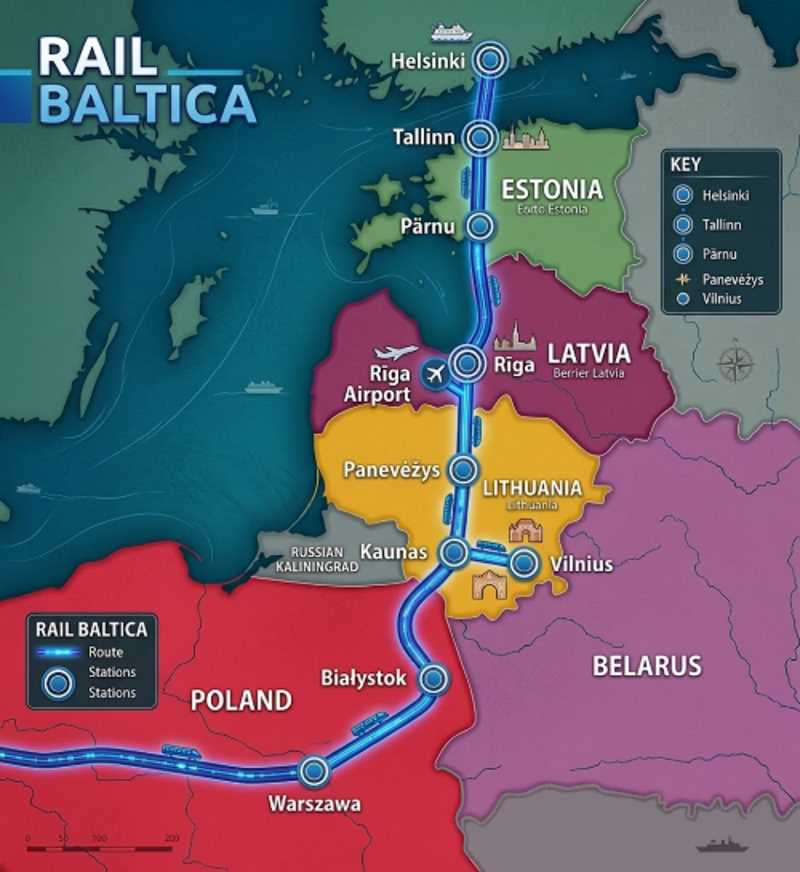
Imagine stepping onto a train in Helsinki. You sip your coffee as the Finnish coastline glides by. A short ferry ride connects you to Tallinn. Then, without changing trains or changing gauges, you continue to Warsaw. Then to Berlin. Then to Paris.
This is not a dream. This is Rail Baltica.
And it is the most important infrastructure project you have never heard of.
The Great Disconnect
Here is a strange fact. The Baltic states of Estonia, Latvia, and Lithuania are in Europe. But their trains do not run on European tracks.
Baltic Rail vs Mainland Europe
| Feature | Baltic Rail System | Mainland Europe |
|---|---|---|
| Track width | 1520 mm (Russian gauge) | 1435 mm (Standard gauge) |
| Direction | East-West (towards Russia) | North-South (towards Europe) |
| Border crossing | Forced change of trains | Seamless travel |
This is a legacy of Soviet occupation. A physical barrier in the ground.
Today, a train from Tallinn to Warsaw is a logistical nightmare. Passengers must disembark at the Polish border. Their luggage is unloaded. Their train wheels are changed—or they board a new train entirely. The delay? Up to a full day.
For freight, this is death. For passengers, it is a deterrent. For Europe, it is an embarrassment.
The Solution: One Track to Connect Them All
Rail Baltica changes this. It is a new, fully electrified, standard-gauge railway. It will connect:
- Helsinki (via ferry to Tallinn)
- Tallinn
- Pärnu
- Riga
- Kaunas
- Vilnius
- Warsaw
From Warsaw, you are connected to the entire European network. Berlin, Vienna, Paris, Rome—all reachable on the same tracks.
Travel Time: Before vs After Rail Baltica
| City Pair | Current Travel Time | Rail Baltica Travel Time | Reduction |
|---|---|---|---|
| Tallinn to Riga | 4+ hours (by bus/car) | 1 hour 42 minutes | ~60% |
| Riga to Vilnius | 3.5+ hours | 1 hour 54 minutes | ~45% |
| Tallinn to Vilnius | 7+ hours | 3 hours 38 minutes | ~48% |
These are not just time savings. These are life savings.
How It Controls Inflation (Yes, Really)
Inflation has many causes. One of them is inefficiency.
When goods are stuck at borders. When trucks burn fuel for hours in traffic. When logistics costs rise—prices rise with them.
Inflation Drivers vs Rail Baltica
| Inflation Driver | How Rail Baltica Helps |
|---|---|
| High transport costs | Rail is 3× cheaper per ton-km than road |
| Fuel price volatility | Fully electrified = immune to diesel prices |
| Supply chain delays | Standard gauge = no border transshipment |
| Labor shortages | One train replaces 40 trucks (and 40 drivers) |
Efficiency is the best cure for inflation. Rail Baltica is efficiency on steel wheels.
A single 40-wagon train replaces a 7 km long convoy of trucks. Less fuel burned. Less road damage. Less driver wages. Lower prices on store shelves.
The Economic Benefits: By the Numbers
The numbers are not small. They are transformative.
Projected Economic Impact
| Economic Indicator | Projected Impact |
|---|---|
| Direct net economic benefits | €6.6 billion |
| GDP growth (Baltic states) | +0.5 to 0.7% annually |
| Total economic benefits (Baltic states) | Up to €48 billion |
| Jobs created during construction | 13,000 direct + 23,000 indirect |
| Permanent operations jobs | 800 |
| Annual passengers by 2046 | 51.7 million |
| Annual freight by 2046 | 10.9 million tons |
This is not a cost. This is an investment with returns.
People and Business: Who Benefits?
For People
Citizen Benefits
| Benefit | Description |
|---|---|
| Commute to work | Access jobs in different cities |
| Study across borders | Live in Riga, study in Vilnius |
| Healthcare access | Reach specialized hospitals faster |
| Cultural exchange | Day trips to museums, concerts, restaurants |
Regional travel times cut by up to 50%. This is not a luxury. This is freedom.
For Businesses
Business Benefits
| Business Type | How They Win |
|---|---|
| Manufacturers | Ship parts and finished goods faster |
| Logistics companies | Lower costs, predictable schedules |
| Tourism operators | New customers from neighboring countries |
| Retailers | Stock shelves from regional warehouses |
| Startups (hardware) | Access to suppliers across three countries |
Businesses stop competing locally. They start scaling regionally.
Goods Transport: Faster, Cheaper, Greener
Today, moving goods from Helsinki to Warsaw is a puzzle.
Freight Mode Comparison
| Mode | Time | Cost (per ton) | CO₂ (per ton-km) |
|---|---|---|---|
| Road (truck) | 3–4 days | High | High |
| Sea (ferry + truck) | 5–7 days | Very high | Medium |
| Current Rail (gauge change) | 4–5 days + 1 day at border | High | Low |
| Rail Baltica | 1–2 days | Low (30–50% less) | Very low (fully electric) |
Rail Baltica is the fastest, cheapest, and greenest option.
And it connects North to South. Finnish paper to Central European printers. Polish machinery to Estonian factories. Latvian timber to German construction sites.
Geopolitics: Adhesion Through Steel
This is not just an economic project. It is a political one.
For decades, the Baltics were oriented East. Their railways were built to serve Moscow. Their trade flowed to Russia. Their security was precarious.
Rail Baltica reorients them West. Permanently.
Adhesion Benefits
| Adhesion Benefit | How It Works |
|---|---|
| Physical integration | Same tracks = same economic destiny |
| Military mobility | NATO troops and equipment move faster |
| Energy independence | Electrification = reduced fossil fuel dependence |
| Symbolic return | Restoring the link severed by Soviet occupation |
As one diplomat put it: "We are not just building a railway. We are correcting history."
The Security Dimension (Dual Use)
Since 2022, this project has gained a new urgency.
Rail Baltica is designed for dual use. Civilian trains by day. Military logistics by night.
Military Benefits
| Military Benefit | Impact |
|---|---|
| Troop movement | Hours instead of days |
| Heavy equipment transport | Tanks and armored vehicles on standard gauge |
| NATO reinforcement | Seamless movement from Germany to the Baltics |
| Border delay elimination | Saves 1 full day per transport from Poland |
A single 40-wagon train replaces a 7 km long military convoy. In a crisis, that matters.
71% of Baltic residents say Rail Baltica strengthens NATO's rapid deployment capability. This is infrastructure as deterrence.
The Cost Reality (Honest Numbers)
Let me be transparent. This project is expensive.
Project Cost Estimates
| Phase | Estimated Cost |
|---|---|
| Original estimate (2017) | €5.8 billion |
| Current estimate (Phase 1, by 2030) | €15.3 billion |
| Full project (after 2030) | Up to €23.8 billion |
Why the increase?
- 51% = more accurate cost data (design advanced)
- 31% = expanded project scope
- 18% = external requirements and inflation (40% inflation in Baltics, 2017–2022)
But the benefits outweigh the costs. By a factor of nearly 3:1.
Beyond Warsaw: The Bigger Vision
Rail Baltica is not the end. It is the beginning.
Future Connections
| Future Connection | Status |
|---|---|
| Warsaw to Berlin | Already exists |
| Berlin to Paris/London | Existing high-speed network |
| Helsinki to the Arctic (Finland's TEN-T network) | Planned |
| Ukraine connection (via Poland) | Future corridor |
Helsinki to Warsaw is one link in a continental chain.
What This Means for You
Reader Takeaways
| Reader Type | Takeaway |
|---|---|
| Business owner | Lower logistics costs, larger market |
| Employee | Access to jobs across borders |
| Student | Study in multiple countries without moving |
| Traveler | Weekend trips from Helsinki to Warsaw |
| Citizen | Stronger Europe, more resilient economy |
This is not a train. This is a platform for a new way of living and working.
The Bottom Line
Rail Baltica is expensive. It is delayed. It has problems.
But it is also necessary.
It integrates the Baltics into mainland Europe—physically, economically, and securely. It controls inflation by reducing logistics costs. It helps people commute, study, and access healthcare. It moves goods faster and cheaper from North to South. It makes countries adhere to each other through shared infrastructure and shared destiny.
Steel tracks are stronger than political fences.
Comments
Write your view after login. Your comment appears only after the moderator approves it.
Or use email and password below.